What Is an Indie Builder?
Learn what an indie builder is, how they differ from traditional startup founders, and the essential skills needed to launch profitable digital products.
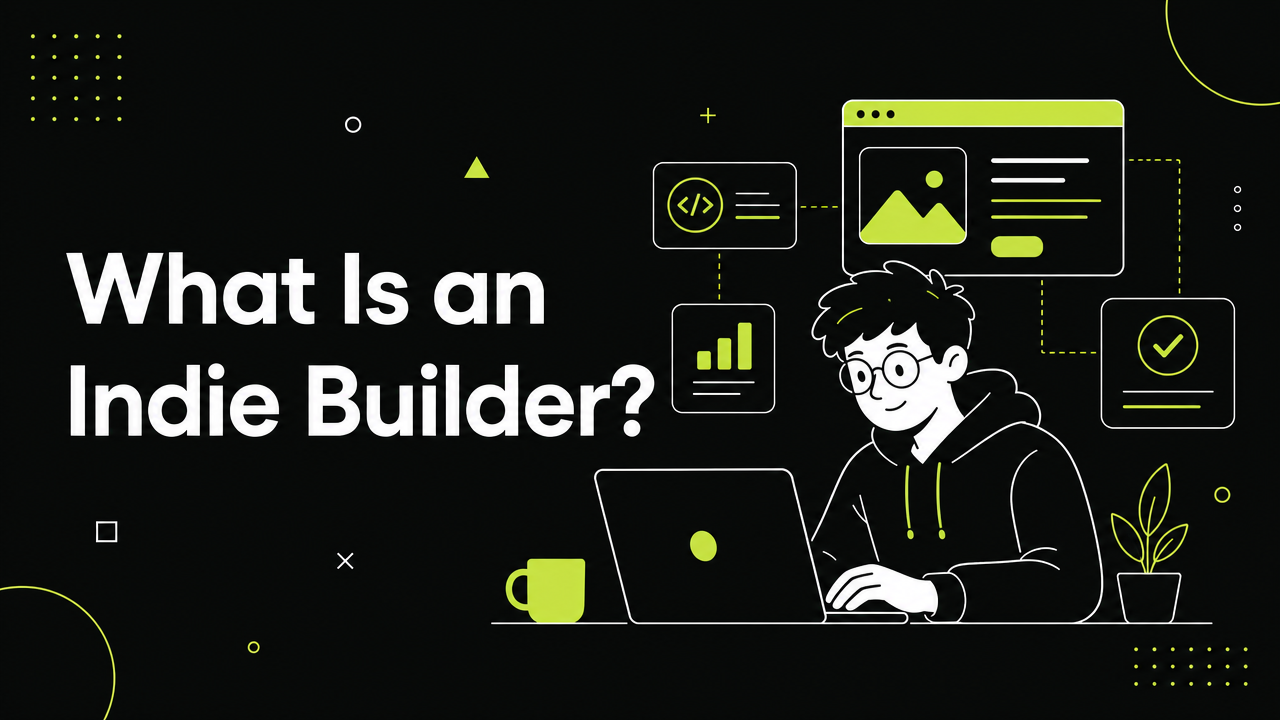
An indie builder is a software developer, designer, or entrepreneur who builds and launches digital products independently, usually without outside venture capital. They focus on creating sustainable, profitable software businesses by leveraging their own skills and limited resources to solve specific problems for a niche audience.
Quick answer: The indie builder checklist
If you are wondering whether you fit the definition of an indie builder, look for these common traits and operational methods:
- Self-funded (Bootstrapped): You rely on personal savings or revenue from the product rather than VC funding.
- Product-led focus: You spend more time building and talking to users than pitching to investors.
- Ownership: You maintain full control over the roadmap, timeline, and exit strategy of the business.
- Multi-disciplinary: You handle coding, marketing, customer support, and design as a solo operator or small team.
- Profit-first mindset: Success is measured by monthly recurring revenue (MRR) rather than user growth at any cost.
How does an indie builder differ from a startup founder?
While the terms are often used interchangeably, the fundamental difference lies in the goal and the funding structure. A traditional startup founder typically seeks high-scale growth fueled by venture capital. Their objective is often a massive exit through an acquisition or IPO within a 5-to-10-year window. They prioritize market share and rapid scaling, often operating at a loss for years.
In contrast, an indie builder prioritizes sustainability and autonomy. They build products that can be profitable from day one or shortly after launch. An indie builder is more likely to build a "lifestyle business"—a term that used to be a pejorative but is now a badge of honor in communities like our leaderboard. For them, success means earning enough to live well while working on projects they enjoy.
What do indie builders actually build?
The scope of indie building is vast, but most projects fall into specific categories. The most common products include Software as a Service (SaaS) tools, browser extensions, mobile apps, digital templates, and niche marketplaces.
Indie builders often look for "boring" problems that large companies ignore. This might be a specialized SEO tool for real estate agents or a custom CRM for independent dog groomers. By focusing on these micro-niches, builders can dominate a small segment of the market without facing direct competition from tech giants.
Why is the indie builder movement growing now?
Several factors have converged to make this the golden age for independent makers. The barrier to entry has never been lower. Low-code and no-code tools allow non-technical founders to build functional prototypes in days. Additionally, cloud infrastructure like AWS and Vercel has made hosting and scaling applications affordable and accessible.
Furthermore, the shift in work culture has encouraged more people to seek autonomy. Many developers and designers are tired of the corporate grind and want to own the value they create. Platforms where you can discover new tools have created an ecosystem where builders can find their first 100 customers without a massive marketing budget.
How do you start your journey as an indie builder?
Starting as an indie builder requires a shift in mindset from being an employee to being a generalist. You cannot just write code; you must learn how to validate ideas and reach customers.
- Identify a pain point: Do not build a solution looking for a problem. Look at your own daily frustrations or browse forums to see what people are complaining about.
- Build a Minimum Viable Product (MVP): Spend the least amount of time possible to create a functional version of your idea. The goal is to see if anyone will actually use it.
- Validate with early users: Before you polish the UI, share your work with a community. You can submit your project to launch platforms to get immediate feedback and initial traffic.
- Iterate based on data: Use the feedback from your first users to decide which features to build next. Avoid "feature creep"—the tendency to add too many things that nobody asked for.
- Focus on distribution: Building is only half the battle. You need to find where your audience hangs out, whether that is on social media, niche subreddits, or through organic search.
What skills does a successful indie builder need?
You do not need to be a master of everything, but you do need to be "dangerous" in several areas. Technical proficiency is a significant advantage, but it is not enough on its own.
Marketing is perhaps the most undervalued skill among new builders. Understanding how to write copy that converts, how to handle basic SEO, and how to build a brand presence is essential for long-term growth. Additionally, you need basic financial literacy to manage your churn rates, customer acquisition costs (CAC), and lifetime value (LTV).
How to handle the challenges of building in public?
Many indie builders choose to "build in public." This involves sharing their progress, revenue numbers, and even their failures on social media. This transparency builds trust and creates a feedback loop with the community.
However, building in public also comes with the risk of copycats and the pressure of external scrutiny. The key is to share the journey without revealing every proprietary secret. Focus on sharing the lessons learned and the milestones achieved, which helps in recruiting early adopters and building a personal brand that lasts beyond a single product.
Should you quit your job to become an indie builder?
It is rarely advisable to quit your primary source of income before your side project shows traction. Most successful indie builders start while working a full-time job. They dedicate a few hours every evening or weekend to their project until the revenue reaches a point where it can cover their basic expenses.
This "bridge" period allows you to take risks without the fear of financial ruin. Once your product hits a certain level of stability, you can transition to full-time indie building with a safety net already in place. You can read more about these transition stories on our blog.
FAQ
Do I need to be a developer to be an indie builder? No, you do not need to be a professional coder. With modern no-code platforms and AI-assisted coding tools, many successful builders are designers or marketers who build and launch complex applications without writing traditional code.
How much money do indie builders make? The income varies wildly. Some builders earn a few hundred dollars a month in passive income, while top-tier indie hackers generate six or seven figures in annual recurring revenue. The goal for most is to reach "default alive" status, where revenue covers all personal and business expenses.
How long does it take to launch a product? An MVP can be launched in as little as a weekend or a few weeks. The key is to avoid spending months in "stealth mode." The faster you launch, the faster you get real market data to inform your next steps.
Where can I find other indie builders? Indie builders congregate in online communities, Discord servers, and niche social networks. Engaging with these communities is vital for staying motivated, finding collaborators, and getting honest feedback on your work.
Ready to share your creation with the world? You can submit your product today or discover what other makers are launching right now on HubNest.